
SEO Is Evolving: How GEO and AEO Are Redefining Search and Advertising
For years, search engine optimization (SEO) has been the foundation of online visibility, helping class action notice campaigns reach potential claimants through search rankings, keywords, and optimized content. However, as artificial intelligence (AI) continues to transform how people search for information, new search methods, such as generative engine optimization (GEO) and answer engine optimization (AEO), are redefining what effective practices of digital notice SEO looks like.
SEO
SEO focuses on improving a website’s placement within organic, non-paid search results on search engine results pages (SERPs). Unlike paid ads, SEO rankings are earned based on relevance, with key factors including domain authority (DA), backlink strength, keyword alignment, content quality, overall user experience, and more. Rankings are assigned to results of search queries which dictate the positioning of each URL displayed on SERPs. For class action notice campaigns, effective SEO helps official settlement websites rank when users search case names, eligibility questions, or filing deadlines. On a SERP, these SEO-driven listings appear beneath any sponsored results and are identified only by their page title and URL, indicating that their position is the result of strong content and credibility rather than advertising spend. This organic visibility builds user trust and captures individuals actively searching for reliable settlement information.
GEO
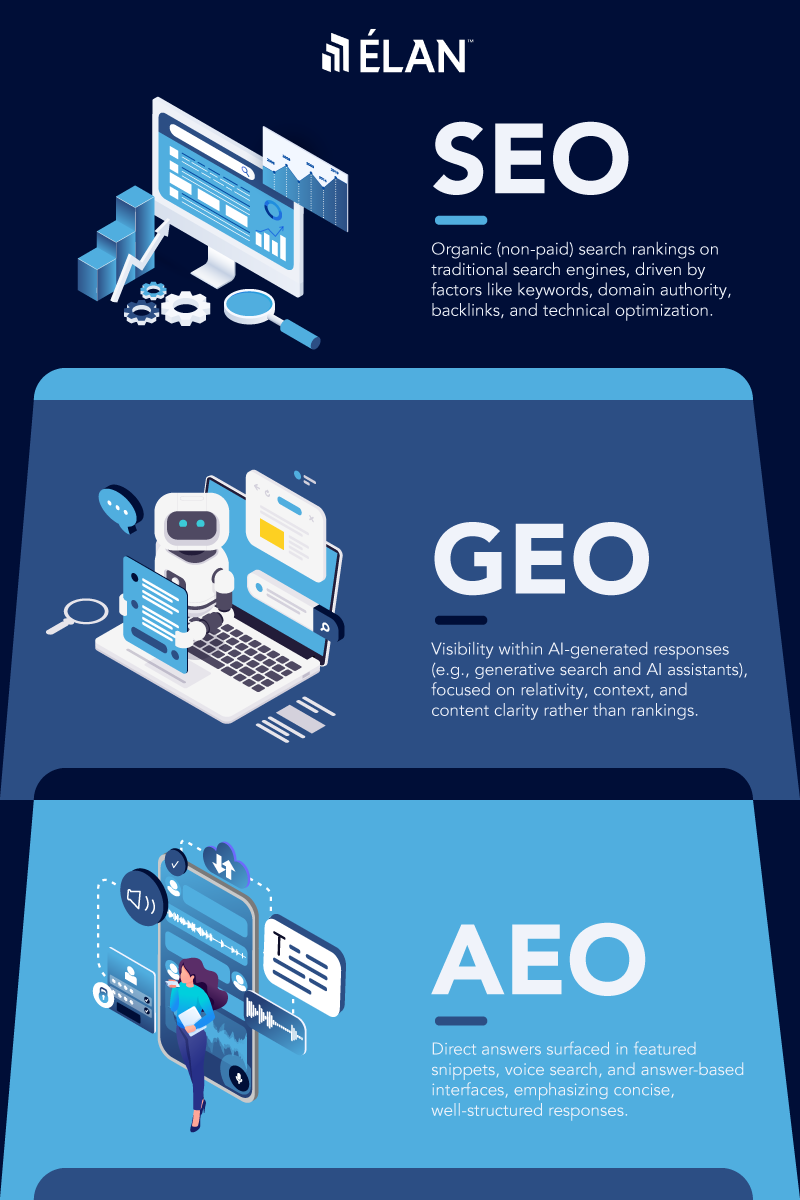
Generative engine optimization focuses on increasing a brand’s visibility within AI-generated search results. Their open API model crawls the internet for relevant data found on a website to answer a user's query. AI-driven engines depend on reliable, well-structured website data to generate accurate summaries and recommendations. Therefore, businesses must focus on producing content that is clearly written, properly sourced, and contextually aligned with intentional user queries. Structured data and a webpage’s schema markup play a critical role in helping AI interpret and retrieve information accurately. For class action webpages to display in a GEO search result, the websites must reflect detailed information that relate closely to a user's search.
AI-driven tools like ChatGPT, Google Gemini, and Perplexity no longer just show lists of links to deliver information; they provide direct, conversational answers. This means potential class members asking questions such as, “Am I eligible for this Settlement?” may now receive an AI-generated response rather than visiting a search result page. Ensuring that detailed settlement information appears on the claims filing website is essential to maintain relevancy in search results through AI.
AEO
Answer engine optimization, in contrast, focuses on content discoverability within systems that provide a single direct response, such as voice assistants and AI-based answer engines. Platforms like Siri, Alexa, and Google Assistant increasingly bypass traditional search results, instead offering users a single, concise answer to their question. AEO demands that content be written with clarity and precision with natural language phrasing of user inquiries in mind. Websites that structure their information as questions and answers, use schema markup effectively, and provide clear factual responses are more likely to be selected as a result. This shift reduces the number of user clicks but increases the value of being featured or referenced in AI-driven answers.
GEO’s preference for detailed content makes it more likely that official settlement websites are referenced in generative search results if information on the website matches a user's search directly. AEO, on the other hand, is structured to deliver concise answers to a user's question in voice and chat-based searches, typically providing only one or two sources, or not quoting sources altogether.
For class action administrators and legal marketing teams, adapting to GEO and AEO ensures that notice plans remain compliant, discoverable, and effective in today’s AI-driven environment. By preparing website content that is structured and optimized for generative systems, campaigns can reach affected audiences where they now seek answers, across both traditional and AI-powered search
Glossary
Search Engine Optimization (SEO): the process of maximizing the number of visitors to a particular website by ensuring that the site appears high on the list of results returned by a search engine. [1]
Generative Engine Optimization (GEO): the practice of structuring digital content to maximize visibility, brand mentions, and citations in AI-powered search results (e.g., ChatGPT, Gemini, Perplexity). [2]
Answer engine optimization (AEO): the practice of structuring website content to be directly surfaced and cited as the primary answer by AI-powered search engines, voice assistants, and chatbots, rather than just ranking as a link in traditional search results. [3]
Search engine results page (SERP): A search engine results page is the page you see when you type in a query in a search engine (like Bing or Google). [4]
References
Google Developers. (2025, December 10). Search engine optimization (SEO) starter guide. Google Search Central. https://developers.google.com/search/docs/fundamentals/seo-starter-guide
Patel, N. (n.d.). What is generative engine optimization (GEO)? NeilPatel.com. https://neilpatel.com/blog/generative-engine-optimization-geo/
Patel, N. (n.d.). Answer engine optimization (AEO): What it is and how to optimize for it. NeilPatel.com. https://neilpatel.com/blog/answer-engine-optimization/
Metric Marketing. (n.d.). The meaning of SERP and how it influences SEO content. MetricMarketing.com. https://www.metricmarketing.com/blog/serp-meaning/
