
What marketers need to know about pricing, placement, targeting, and early access opportunities
ChatGPT is one of the most widely used generative AI tools in the world. Users rely on it to ask questions, research topics, and get guidance in real time. OpenAI announced it is beginning to test ads inside ChatGPT, marking a shift from a fully ad-free experience to a partially ad-supported model.
This change introduces a new type of intent-driven advertising, where ads are shown based on what a user is actively asking rather than their passive browsing behavior.
Rollout and Availability
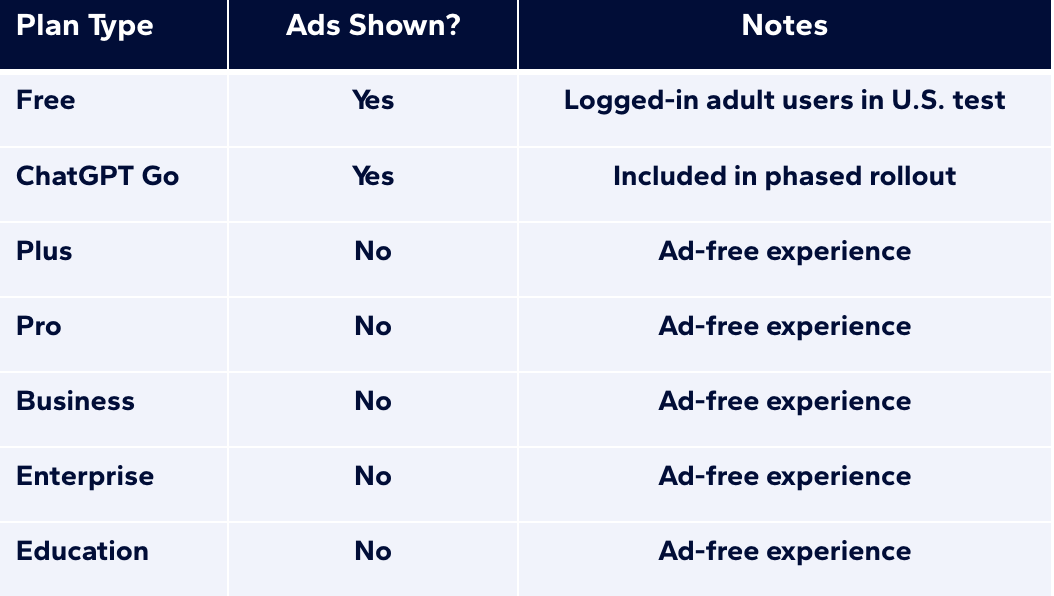
OpenAI has announced that ads will begin testing in the United States. The test will include logged-in adult users on the Free plan and the lower-cost ChatGPT Go tier.
Users on paid plans such as Plus, Pro, Business, Enterprise, and Education will not see ads. The rollout is limited and phased, and OpenAI has not yet announced a full public launch timeline.
Pricing and Budget Expectations
OpenAI has not publicly released official pricing, auction mechanics, or campaign minimums.
However, industry reporting from Adweek indicates that select advertisers participating in early testing were presented with a minimum commitment of approximately $200,000. This figure has not been confirmed in OpenAI’s official announcements and should be viewed as an early pilot requirement rather than a finalized pricing structure.
Early reports also suggest that ad pricing may be positioned at a premium compared to traditional digital platforms, reflecting the high-intent nature of ChatGPT usage.
How Ads Will Appear
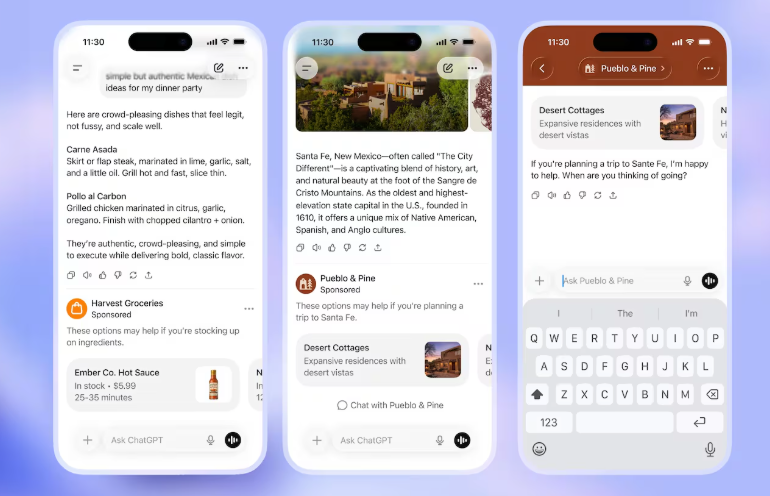
OpenAI's ad mockups show ways brands could get their messages across in paid placements, including guiding users into chats with a sponsor. (OpenAI)
Ads will be clearly labeled as sponsored content and will appear below ChatGPT’s responses when relevant to the user’s query.
They are designed to be visually separate from the AI’s answer and will not interrupt or alter the response itself. In some cases, ads may allow users to interact or ask follow-up questions related to the sponsored content. For example, a sponsored travel offer might include an option to explore flight deals or ask additional questions about the destination without affecting the original AI response.
The experience is closer to intent-based PPC than social media feed ads, as it responds to a user’s specific query rather than interrupting passive browsing.
Targeting and Personalization
At launch, ad placement will primarily be based on the context of the conversation. Ads are matched to what the user is asking in real time rather than broad demographic or interest targeting.
Users can turn off ad personalization and manage ad data in their settings. Ads will not appear for users under 18 and will not be shown alongside sensitive topics such as health, mental health, or politics.
OpenAI has not yet disclosed whether advertisers will have access to traditional targeting tools such as demographic filters, geographic radius targeting, or retargeting audiences.
User Privacy and Control
OpenAI has stated that ads do not influence ChatGPT’s answers. The AI’s responses remain independent from advertising.
User conversations are not sold to advertisers, and private chats are not shared for ad targeting. Users who prefer not to see ads can maintain an ad-free experience by using paid subscription tiers.
Competitive Landscape
ChatGPT is not alone in exploring advertising within AI tools. Perplexity has begun testing sponsored elements within its answer experience, and Microsoft has experimented with ads inside Copilot surfaces.
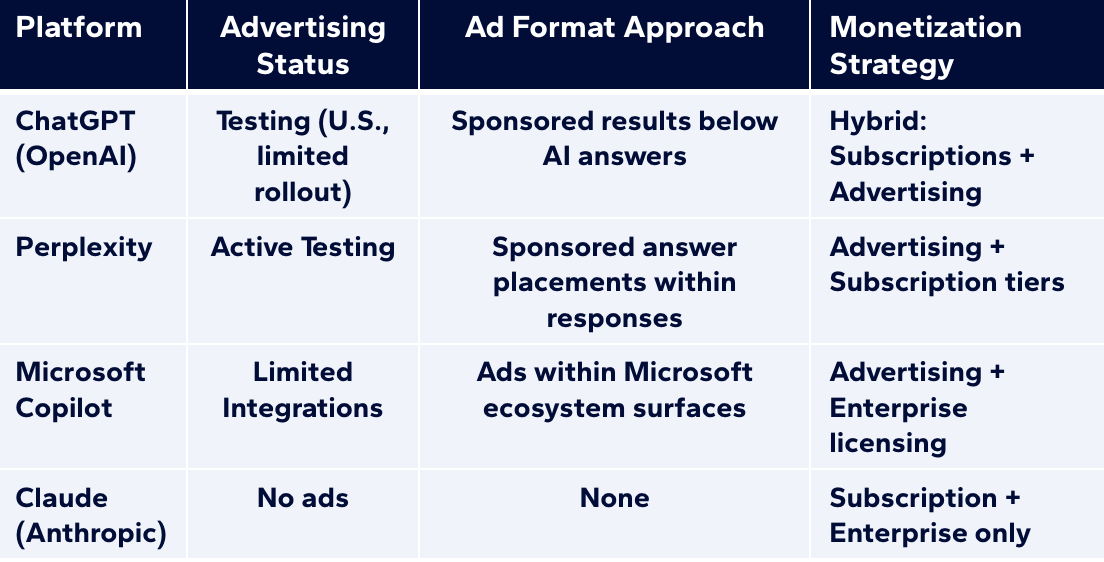
Other AI companies, such as Anthropic with Claude, have publicly committed to remaining ad-free, creating a clear distinction in monetization strategies across platforms.
What Is Still Unknown
OpenAI has not yet shared details on how advertisers will buy ads, how performance will be measured, or how attribution will work.
It is also unclear when ads will expand beyond the United States or whether pricing and minimum spend requirements will change after the testing phase.
Key Takeaway
ChatGPT advertising represents a new category of intent-driven media. Ads appear when users are actively asking questions, creating opportunities to reach people at moments of high intent.
Early access appears limited and potentially expensive, positioning ChatGPT ads as a premium advertising channel during initial testing. As the platform evolves, pricing, targeting options, and measurement tools are expected to become clearer.
Be first where intent is highest.
Contact Élan to evaluate whether ChatGPT advertising should be part of your next growth initiative.
